Zhejiang Huayou Cobalt Co., Ltd. was founded in 2002 and listed on the Shanghai Stock Exchange in 2015.
Background
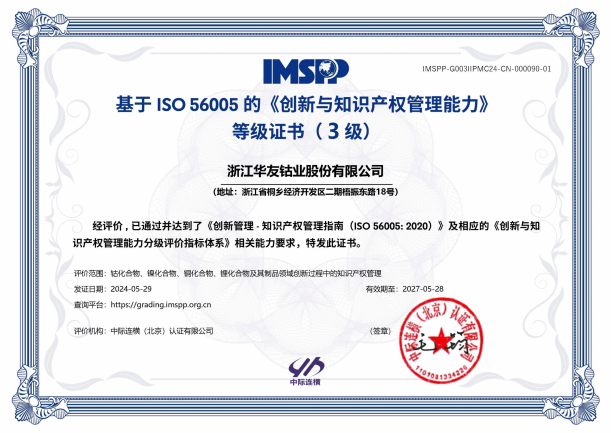
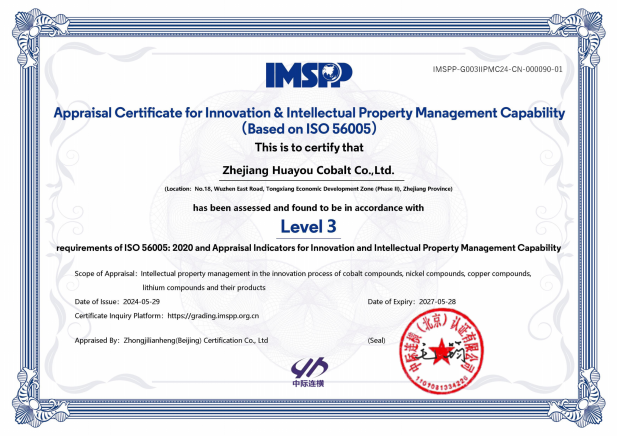
Zhejiang Huayou Cobalt Co., Ltd. was founded in 2002 and listed on the Shanghai Stock Exchange in 2015. It is a high-tech enterprise with an integrated industrial chain from cobalt, nickel, and lithium resource development to lithium battery material manufacturing. The company is committed to developing low-carbon and environmentally friendly new energy lithium battery materials, with a comprehensive industry portfolio covering resource development, manufacturing, and recycling. The company focuses on the three major businesses of "resources, new materials and new energy" to build a vertically integrated industrial chain, with mature global market development and outstanding technological innovation capabilities. Until now, the company holds 574 nationally authorized patents and has received China Patent Excellence Awards and Science and Technology Advanced Awards multiple times. It has also been recognized as a leading innovative company in Zhejiang Province and a National Intellectual Property Excellence Organization.

Innovation Challenges and Development Needs
Zhejiang Huayou Cobalt Co., Ltd. focuses on developing the lithium battery new energy materials. By following the strategic "upstream resource control, downstream market expansion, and midstream capability enhancement," the company fully implements the "Two New, Three Transformations" strategy. Its goal is to maintain global leadership in the cobalt new materials industry and become an industry leader in lithium battery new energy materials. There is a strong need to enhance the realization of innovation value. By leveraging the ISO 56005 international standard, the company aims to define intellectual property (IP) management objectives and roadmap, thereby comprehensively improving innovation efficiency and effectiveness.
Benefits of Implementing Grading Evaluation
1.Enhanced Integration of Innovation and IP Management: By utilizing ISO 56005, Huayou Cobalt has deeply employed IP management into the entire innovation process, significantly improving management efficiency from strategic planning to implementation.
2.Optimization of Systems and Processes: A series of management systems are established and refined during the evaluation process, including patent discovery, trademark management, patent portfolio, and IP agency management, ensuring management processes align with needs.
3.Strengthened Core Competitiveness: Through patent strategy analysis and Freedom to Operate (FTO) analysis, the company optimized its IP portfolio, enhancing core technology protection and establishing the foundation for innovation value realization.
4.Enhanced Digitalization of IP Management: The company upgraded its ERP IP management system, integrating a high-value patent evaluation model to achieve full-process digital management, thereby improving the precision and efficiency of IP operations.
Best practice experiences
1.Leadership Support and All level Fully Engagement: Top management actively involved in IP strategy deployment and resource allocation, while employees at all levels were engaged through training and performance incentives to integrate into IP management efforts.
2.Systematic Approach: A "division of responsibilities with coordinated approach" management policy was established, resulting in horizontal collaboration and vertical interaction work model to ensure steady progress in innovation and IP management.
3.Enhanced Professional Capabilities: Through benchmarking analysis and multiple trainings by evaluation agencies, the professional skills of the company’s IP and R&D teams were significantly improved, particularly in patent search, writing, and analysis.
4.Flexible Leverage of International Standards: The company adapted ISO 56005 requirements to its actual conditions, implementing the standard in phases to ensure its effective execution while addressing specific challenges in the innovation process.
5.Integration of Corporate Culture and Incentives: A corporate culture of "protecting and encouraging innovation" was cultivated, with a comprehensive patent reward and incentive. A patent liaison network was also established to encourage employees to explore their innovation potential and enhance low level innovation.