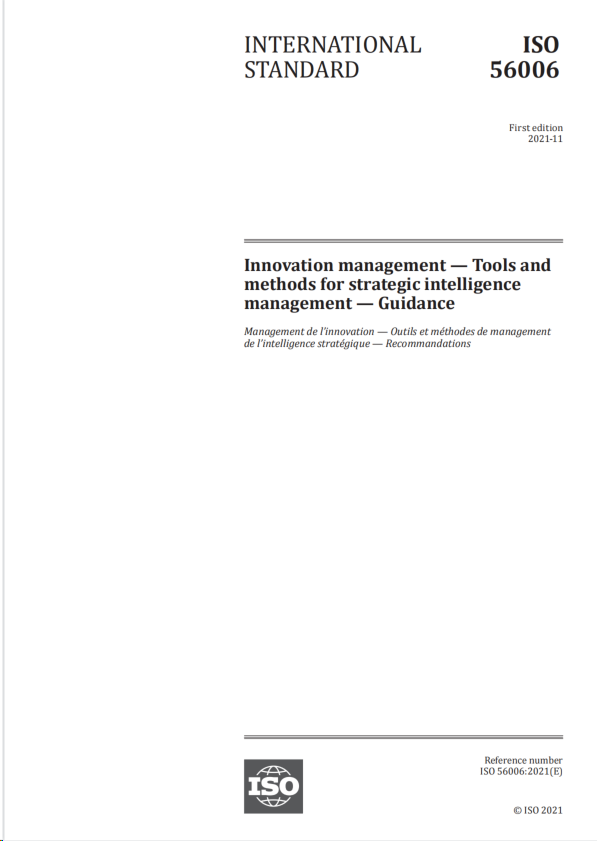
Standards
ISO 56008:2024
Published
Read sample >
Innovation management — Tools and methods for innovation operation measurements — Guidance
This document provides guidance for the definition, implementation, evaluation, and improvement of the measurements necessary to effectively manage innovation activities in an organization. It establishes the fundamentals of innovation operation measurements and guides their application towards four areas: — measurements for establishing and launching innovation initiatives; — measurements for innovation processes; — measurements for innovation initiatives; — measurements of innovation portfolios. This document is applicable to: — organizations that are seeking to define and implement an innovation operations measurement approach; — organizations and interested parties seeking to improve the areas of accountability, transparency, and evidence-based assessment of innovation operations; — customers, investors, and other interested parties, seeking confidence in the organization’s innovation operations management and its results; — providers of training in innovation operations and measurements, including assessment of and consultancy for achieving results; — experts in innovation operations evaluation and impact assessment, favoring the use of a harmonized international guidance standard; — innovation policy makers and program managers who are looking to obtain evidence of progress and desired outcomes of innovation activities supported through public policies and programs. All of the guidance provided within this document is generic and intended to be applicable to: — all types of organizations regardless of sector or size, whether they be private, public, not-for-profit, governmental or societal; — all types of innovations (e.g. product, service, process, model, and method) ranging from incremental to radical; — all types of time horizons, from short-term to long-term evaluation and measurement.
Technical Committee: ISO/TC 279
立即购买
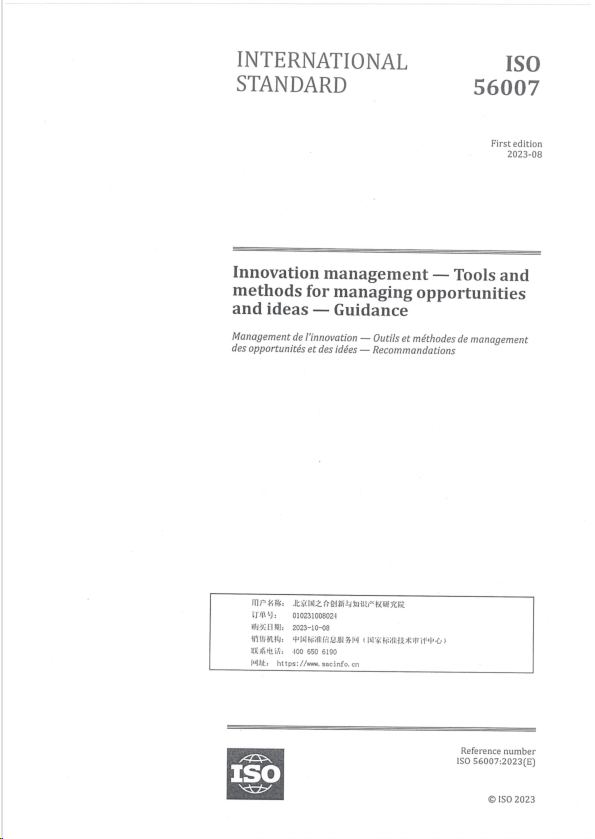
ISO 56007:2023
Published
Read sample >
Innovation management — Tools and methods for managing opportunities and ideas — Guidance
This document provides guidance on managing opportunities and ideas by: — explaining the reasons for and the value of managing ideas effectively; — describing how to prepare for front end innovation activities; — addressing people and organization issues, including innovation leadership, culture and strategy; — detailing innovation activities and their interrelationships; — outlining activity and process evaluation considerations that are important for innovation success. A sub-set of processes are addressed as described in ISO 56002, i.e. identifying opportunities, creating concepts, and validating them. The activities within these processes, when managed together, bring forward viable innovation concepts for development. Developing these innovation concepts into solutions and deploying these solutions is addressed by ISO 56002 and is outside the scope of this guidance document. This document provides guidance for any innovation type along the continuum from incremental to radical innovation, as defined in ISO 56000. This guidance is intended for: — any user involved in innovation, whether for an organization or individual; — any organization type or scale; — any understanding of value creation and realization, whether for profit, social impact, changes in strategic direction, or any other purpose. This document can help organizations to systematically manage their opportunities and ideas to realize greater value from front end innovation activities to arrive at go/no–go decisions for development. There is no one method or set of tools for use in all situations. Choice is impacted by a range of related considerations to be addressed in this document.
Technical Committee: ISO/TC 279
立即购买
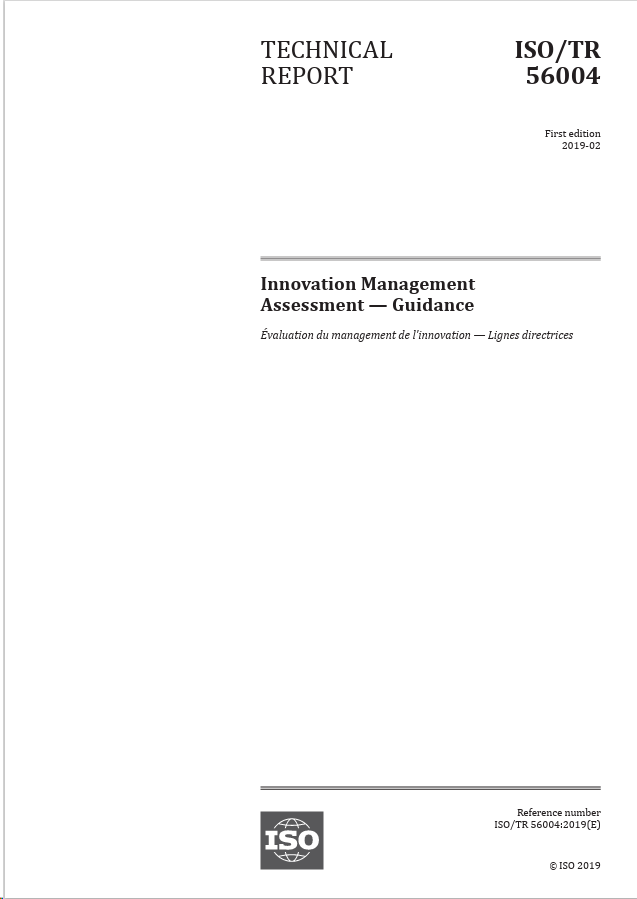
ISO/TR 56004:2019
Published
Read sample >
Innovation Management Assessment — Guidance
This document will help the user understand why it is beneficial to carry out an Innovation Management Assessment (IMA), what to assess, how to carry out the IMA, and thus maximize the resulting benefits, which are universally applicable to: — organizations seeking sustained success in their innovation activities; — organizations performing IMAs; — users and other interested parties (e.g. customers, suppliers, partners, funding organizations, universities and public authorities) seeking confidence in an organization's ability to manage innovation effectively; — interested parties seeking to improve communication through a common understanding of Innovation Management (IM), via an assessment; — providers of training, assessment, or advice in IM; — developers of related standards; — academics interested in research related to IMA. Further, this document is intended to be applicable to: — all types of organizations, regardless of sector, age, size, or country; — all approaches to IM regardless of their level of sophistication, and complexity; — all modalities of managing innovation whether centralized or decentralized; — all ways to innovate, e.g. internal, collaborative, open, user-, market- or technology-driven innovation; — all types of innovation such as product, service, process, business model, organizational innovation from incremental to radical.
Technical Committee: ISO/TC 279
立即购买
ISO 56000:2020
Published
Read sample >
Innovation management -Fundamentals and vocabulary
1.1 This document provides the vocabulary, fundamental concepts and principles of innovation management and its systematic implementation. It is applicable to:a) organizations implementing an innovation management system or performing innovation management assessments;b) organizations that need to improve their ability to effectively manage innovation activities;c) users, customers and other relevant interested parties (e.g. suppliers, partners, funding organizations, investors, universities and public authorities) seeking confidence in the innovation capabilities of an organization;d) organizations and interested parties seeking to improve communication through a common understanding of the vocabulary used in innovation management;e) providers of training in, assessment of, or consultancy for, innovation management and innovation management systems;f) developers of innovation management and related standards. 1.2 This document is intended to be applicable to:a) all types of organizations, regardless of type, sector, maturity-level or size;b) all types of innovations, e.g. product, service, process, model and method, ranging from incremental to radical;c) all types of approaches, e.g. internal and open innovation, user-, market-, technology- and design-driven innovation activities.This document specifies the terms and definitions applicable to all innovation management and innovation management system standards developed by ISO/TC 279.
Technical Committee: ISO/TC 279
立即购买
ISO 56002: 2019
Published
Read sample >
Innovation management -Innovation management system Guidance
1.1 This document provides guidance for the establishment, implementation, maintenance, and continual improvement of an innovation management system for use in all established organizations. It is applicable to:a) organizations seeking sustained success by developing and demonstrating their ability to effectively manage innovation activities to achieve the intended outcomes;b) users, customers, and other interested parties, seeking confidence in the innovation capabilities of an organization;c) organizations and interested parties seeking to improve communication through a common understanding of what constitutes an innovation management system;d) providers of training in, assessment of, or consultancy for, innovation management and innovation management systems;e) policy makers, aiming for higher effectiveness of support programs targeting the innovation capabilities and competitiveness of organizations and the development of society. 1.2 All the guidance within this document is generic and intended to be applicable to:a) all types of organizations, regardless of type, sector, or size. The focus is on established organizations, with the understanding that both temporary organizations and start-ups can also benefit by applying these guidelines in all or in part;b) all types of innovations, e.g. product, service, process, model, and method, ranging from incremental to radical;c) all types of approaches, e.g. internal and open innovation, user-, market-, technology-, and design-driven innovation activities.It does not describe detailed activities within the organization, but rather provides guidance at a general level. It does not prescribe any requirements or specific tools or methods for innovation activities.
Technical Committee: ISO/TC 279

立即购买
ISO/TR 56004:2019
Published
Read sample >
Innovation Management Assessment Guidance
This document will help the user understand why it is beneficial to carry out an Innovation Management Assessment (IMA), what to assess, how to carry out the IMA, and thus maximize the resulting benefits, which are universally applicable to: — organizations seeking sustained success in their innovation activities; — organizations performing IMAs; — users and other interested parties (e.g. customers, suppliers, partners, funding organizations, universities and public authorities) seeking confidence in an organization's ability to manage innovation effectively; — interested parties seeking to improve communication through a common understanding of Innovation Management (IM), via an assessment; — providers of training, assessment, or advice in IM; — developers of related standards; — academics interested in research related to IMA. Further, this document is intended to be applicable to: — all types of organizations, regardless of sector, age, size, or country; — all approaches to IM regardless of their level of sophistication, and complexity; — all modalities of managing innovation whether centralized or decentralized; — all ways to innovate, e.g. internal, collaborative, open, user-, market- or technology-driven innovation; — all types of innovation such as product, service, process, business model, organizational innovation from incremental to radical.
Technical Committee: ISO/TC 279
立即购买
ISO 56007:2023
Published
Read sample >
Innovation management -Tools and methods for managing opportunities and ideas Guidance
This document provides guidance on managing opportunities and ideas by: — explaining the reasons for and the value of managing ideas effectively; — describing how to prepare for front end innovation activities; — addressing people and organization issues, including innovation leadership, culture and strategy; — detailing innovation activities and their interrelationships; — outlining activity and process evaluation considerations that are important for innovation success. A sub-set of processes are addressed as described in ISO 56002, i.e. identifying opportunities, creating concepts, and validating them. The activities within these processes, when managed together, bring forward viable innovation concepts for development. Developing these innovation concepts into solutions and deploying these solutions is addressed by ISO 56002 and is outside the scope of this guidance document. This document provides guidance for any innovation type along the continuum from incremental to radical innovation, as defined in ISO 56000. This guidance is intended for: — any user involved in innovation, whether for an organization or individual; — any organization type or scale; — any understanding of value creation and realization, whether for profit, social impact, changes in strategic direction, or any other purpose. This document can help organizations to systematically manage their opportunities and ideas to realize greater value from front end innovation activities to arrive at go/no–go decisions for development. There is no one method or set of tools for use in all situations. Choice is impacted by a range of related considerations to be addressed in this document.
Technical Committee: ISO/TC 279
立即购买
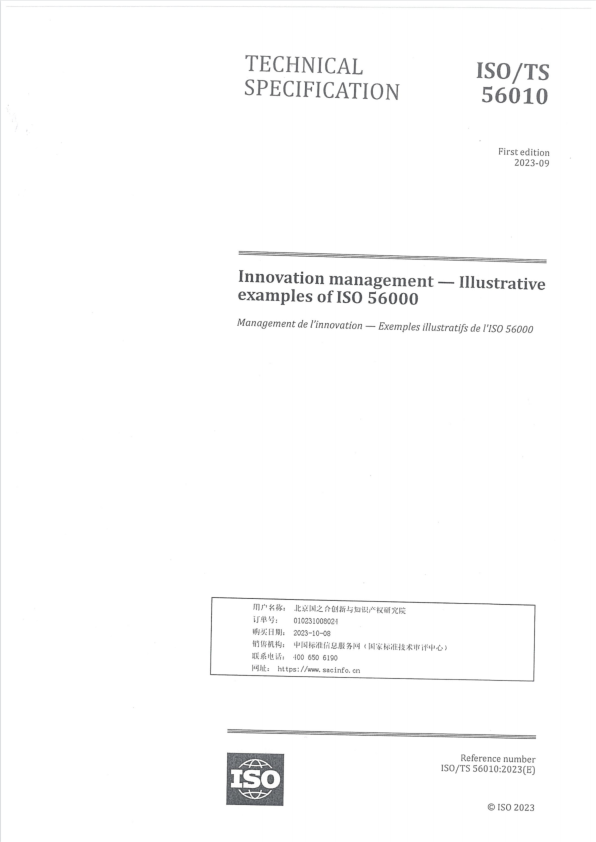
ISO/TS 56010:2023
Published
Read sample >
Innovation management -Illustrative examples of ISO 56000
This document provides descriptions, context, and examples for selected concepts of innovation management defined in ISO 56000, chosen to provide understanding of the most essential concepts in innovation management. This document does not explain “how to” innovate or manage innovation, but it enables understanding of the language and concepts used in communication related to innovation and innovation management. Descriptions, examples, and infographics are used throughout this document, both to illustrate concepts and to differentiate between concepts. The examples have been chosen from a variety of industries and sectors with a focus on different types of innovations and are non-exhaustive. The document is intended to be used by: a) organizations implementing an innovation management system, or performing innovation management assessments; b) organizations that need to improve their ability to effectively manage innovation activities; c) users, customers, and other interested parties (internal and external) seeking to ground and improve communication through a common understanding of the vocabulary used in innovation management; d) providers of training in, assessment of, or consultancy for, innovation management and innovation management systems; e) developers of innovation management and related standards. This document uses examples to make concepts more comprehensible and is intended to be used as: — An introduction: Interested parties can be onboarded to the documents published as part of the ISO 56000 family of standards, bridging the gaps between alternative views, beliefs, and conceptions of innovation and the science and practice of innovation management. — A guideline: This document presents key technical definitions and concepts in a descriptive format suited to broad and non-technical audiences and can be used to provide basic understanding to organizations, academia, media, and other interested parties as the agreed upon standards become available to the world.
Technical Committee: ISO/TC 279
立即购买
Download Retract
Guide to ISO 56001_CN
"Innovation Management Collection"Issue 4
"Innovation Management Collection"Issue 2
"Innovation Management Collection"Issue 3
"Innovation Management Collection"Issue 1